
ARLINGTON’S BUDGET
Arlington sets its budget every year as part of a multi-year plan, a model used by other communities throughout the state because of its success. And it has worked well in Arlington:
- The Town has never come back to the town for an override earlier than it promised to.
- Arlington regularly commits to (and meets) annual limits on budget growth, even when those limits are below inflation. In 2021 and 2022, for instance, when inflation spiked to 7% and 6.5%, the town held its general government operating budget to 2% growth (FY22) and 2.6% growth (FY23).
- The town maintains the highest (AAA) bond rating.
Despite these strengths, in April of 2025 the Arlington Finance Committee informed Town Meeting and the community to expect a deficit in FY2027 (starting July 1, 2026), unless there was a change in revenue or expenses.
How Did We Get Here?
Proposition 2½
Proposition 2½ limits property tax revenue to 2.5% growth each year (excluding new construction) unless the voters approve an increase. In all of the last 5 years, however – and in most of the years since Prop 2½ was passed in 1980 – inflation alone has exceeded 2.5%. This puts significant downward pressure on the Town budget.
Many municipal leaders and the organization representing municipalities across the Commonwealth are advocating for changes in the Proposition 2 ½ law. However, the law does give a Town’s voters the power to determine how much they will pay in property taxes.
In recent years, rising costs outside of control of the Town of Arlington have put additional pressure on local government. Here are examples of the increased costs Arlington is facing.
Supplies and Services
The supplies and services needed to run the town have in some cases experienced double or triple digit percent increases. The following are examples of the increase in cost to install or buy these items from FY 2024 to FY 2026:
Road Salt
+18%
Firefighter Turnout Gear
+25%
Concrete Sidewalk
+26%
Hot Mix Asphalt Walk Surface (per ton)
+91%
Reflectorized Roadway White Line 4”
+110%
Manhole
+176%
Water Main Ductile Iron Pipe (per linear foot)
+215%
Catch Basin
+215%
Reflectorized Yellow Line 12” (per linear foot)
+320%
12” Corrugated Plastic Pipe (per linear foot)
+530%
Health Insurance
In 2023 when the last override vote was held, health insurance spending was expected to increase at 5.5% each year. At the time, it was a reasonable estimate. Instead Arlington is about to budget double digit percent increases for the third consecutive year. The current estimate for this year is 11.25%, an increase of almost $3 million.
Utilities
Arlington does bulk purchasing and buys futures contracts to save money and provide for a predictable supply rate for its utilities. It cannot do this for delivery rates. From FY2023 to FY2025, the supply rate Arlington pays for natural gas costs went up 5.5% at the same time the delivery rate increased 19%. The total percentage of the increase is 13.6%. Electricity over the same time grew by 9%.
Recycling and Trash
To save money, Arlington recently switched to automated trash pick-up with stricter limits on the amount of trash allowed per household. However, even with the new contract, waste and recycling processing costs are projected to increase 6% from FY2026 to FY2027.
An even more expensive problem is single stream recycling. When Arlington signed its new contract, Arlington expected to pay $58/ton. When the bottom fell out of the recycling market, the price went up. During the first five months of FY2026 alone, the Town paid the following per ton – $92.95, $100.33, $100.95, $102.65, $104.67. Arlington estimated producing 4400 tons of recycling in FY2026.
How Do We Balance The Budget?

Increase Property Taxes
The majority of Arlington’s revenue comes from property taxes – which can only increase 2 ½% each year due to Proposition 2 ½. (Read how Proposition 2 ½ works here.) Commercial and industrial sectors make up less than 6% of the total tax levy. The rest is residential. It’s how Arlington grew as a town and continues because people love to live here. To balance our budget with property tax revenue, we must pass an override vote and increase the amount Arlington can collect.
Increase State Aid
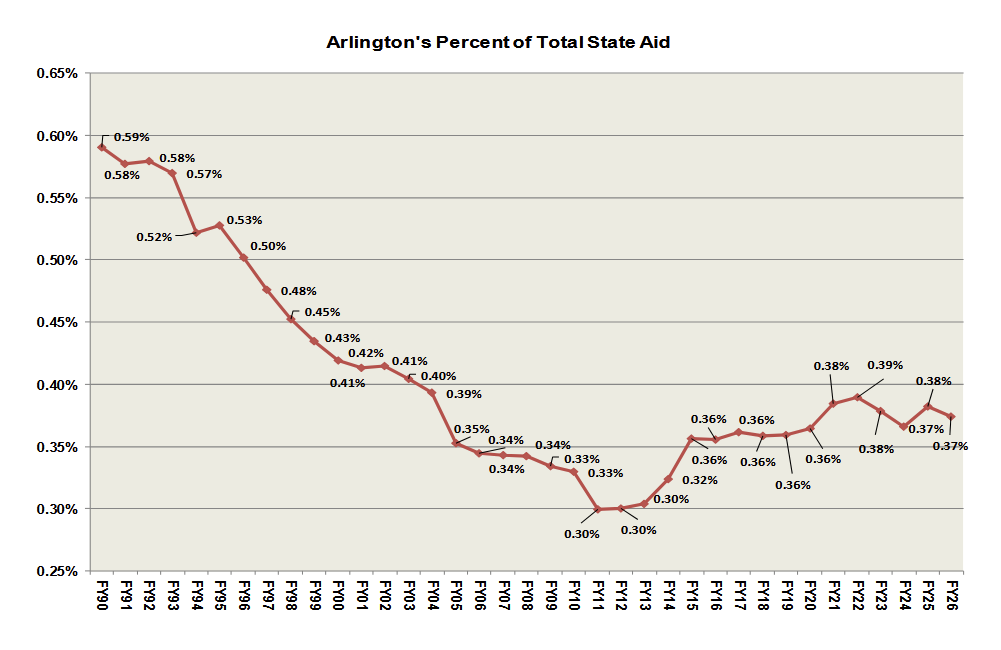
Unfortunately Arlington has no control over how much state aid we get, and what we receive depends on what the state has to distribute. UGGA (Unrestricted General Government Aid) was deeply cut between FY2008 and FY2011 – only reaching 2008 levels in FY2026. Adjusted for inflation, the total UGGA released in 2025 was 25% lower than it was in 2002. In addition, Arlington’s share of total state aid is limited by state aid formulas, which allocate more aid to low income and low wealth communities.
Increase Other Revenue Sources
Arlington has some other sources of income including motor vehicle excise tax, licenses and permits, rental income from town properties, departmental fees, interest income, and taxes from meals, hotels and marijuana sales, which make up around 5% of our revenue. There are some cash reserves and other funds, but there are limits on how they can be used. Whenever an override is passed, the amount is set so some of the increased taxes are saved to be used later to put off asking for another override, but Arlington will use the last of it in FY2027.
Make Cuts
The Town and Schools are trying to deal with increasing costs in some areas by making reductions in other areas. For instance, the school department plans to reduce positions in FY2027—regardless of whether an override passes—resulting in estimated savings of $910,000 to $1,475,000 which they can use to offset increased transportation and energy costs through a reallocation of resources. They are shifting where money is spent, but it isn’t enough to prevent painful cuts if an override doesn’t pass.
The Superintendent presented a list of proposed cuts to the School Committee, and this presentation is available online. A summary of the cuts is available on this website. The Town Manager is currently finalizing his proposed cuts in consultation with his department head and the Select Board. As they are announced, we will publish them.
Are there any other options if an override doesn’t pass?
There are not enough other options which will allow Arlington to balance its budget. If the override does not pass, the town and schools must make cuts until the budget is balanced.
More detailed explanations of Arlington’s budget planning process, how Arlington compares to other communities, Proposition 2 ½, operating overrides, and what tax relief is available to taxpayers are available at our FAQ.