FAQ
Proposition 2 1/2, Operating Overrides & Arlington
- What is Proposition 2 1⁄2 ?
- What is an operating override?
- Why does Arlington need operating overrides?
- What is the Town Manager 12? Why are these comparable communities?
- How does Arlington’s school spending compare to school spending in similar communities?
- How has the number of students in the schools changed?
- As our property values go up, doesn’t the Town get more money in taxes?
- Why has my tax bill gone up more than 2 1⁄2 percent some years?
- When did Arlington last approve an override?
What Are The Details Of The Upcoming Override Vote?
What If The Override Doesn’t Pass?
Tax Relief
- Are options available for residents who can’t afford the tax increases?
- What has Arlington done to expand tax relief programs?
Arlington’s Planning Process
- What is the budget planning process for the town?
- What is the budget planning process for the schools?
- Are the positions at the town and school levels created with Federal government funding in response to the pandemic still in place?
The Campaign
Proposition 2 1/2, Operating Overrides & Arlington
What is Proposition 2 1⁄2 ?
Proposition 2 1⁄2 is a state law passed in 1980 that controls how much money towns can collect from property taxes. Under Prop 2 1⁄2, the town can only bring in up to 2 1⁄2 percent more property tax revenue town-wide each year than the last, excluding new construction — even if property values rise faster than 2 1⁄2 percent. Any increase beyond this levy limit must be approved directly by the majority of voters.
What is an operating override?
When the cost of town services exceeds the limits of Proposition 2 1⁄2, communities may ask voters to consider a ballot initiative for an operating override. An override permits a permanent property tax increase greater than the 2 1⁄2 percent limit, though rate increases are limited to 2 1⁄2 percent in subsequent years. The ballot initiative must specify exactly how much additional revenue is being sought.
Why does Arlington need operating overrides?
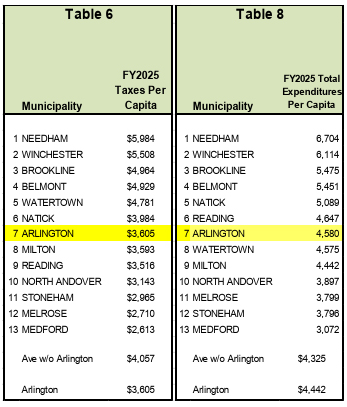
Like many other Massachusetts communities, our town has a structural deficit created by Proposition 2 ½ . This means that costs for providing the same level of services year-to-year rise faster than revenue. Arlington spends frugally — in the bottom half of per capita spending relative to its comparable communities and the bottom half for taxes per capita. Town spending does not create a structural deficit; a lack of revenue does.
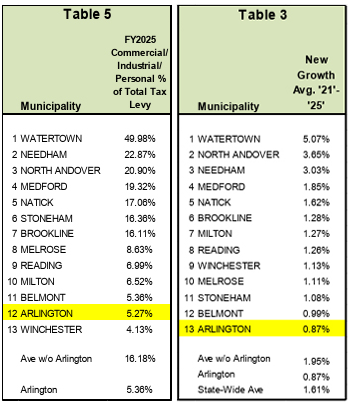
Arlington has and will continue to look for sources of revenue other than residential taxpayers, but our tax base is almost all residential. Commercial and industrial sectors make up less than 6% of the total. For many communities, new growth is an important revenue source. Arlington’s five-and-a-half square mile area is almost completely built out. Our new growth remains at the bottom of comparable communities and falls short of the state-wide average.
What is the Town Manager 12? Why are these comparable communities?
The Town Manager 12 is a group of 12 municipalities that have similar characteristics to Arlington. This group is useful for benchmarking Arlington’s spending. The towns are: Belmont, Brookline, Medford, Melrose, Milton, Natick, Needham, North Andover, Reading, Stoneham, Watertown, and Winchester.
These 12 communities were selected by town, school, and union leadership based on population, 5-year average municipal growth factor, population per square mile, median income per capita, median income per household, single family median home value, average family tax bill, total tax levy, excess capacity as a percentage of maximum levy, and residential valuation as a percentage of the total tax levy.
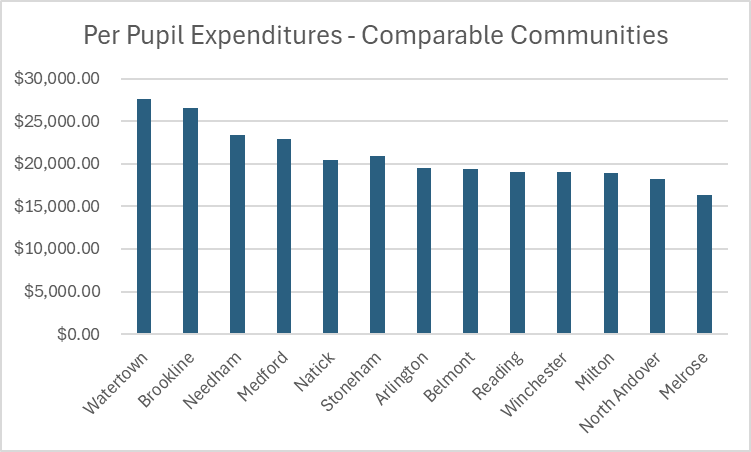
How does Arlington’s school spending compare to school spending in similar communities?
The Massachusetts Department of Elementary and Secondary Education tracks per pupil spending for all districts. In the 2023–2024 academic year, Arlington’s total per pupil spending was $19,471. This is below both the state average ($21,885) and the Town Manager 12 average ($22,682).
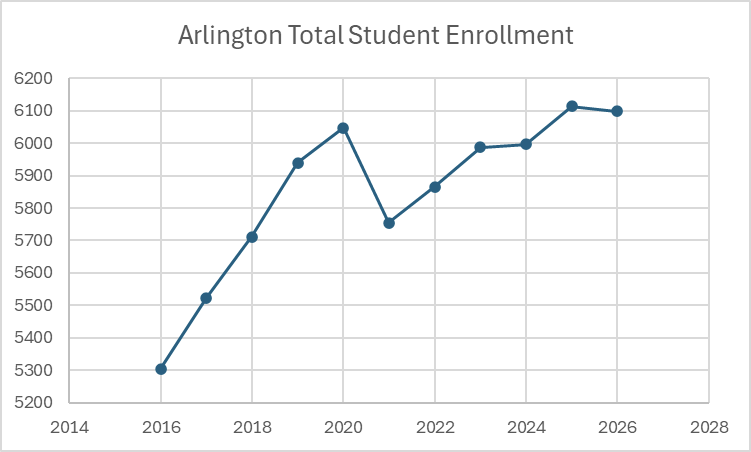
How has the number of students in the schools changed?
As our property values go up, doesn’t the Town get more money in taxes?
No. The total amount in property taxes that the Town can collect is limited to a 2.5% increase each year, excluding new growth, regardless of any changes in property values. When property values increase, the tax rate has to be adjusted so the total amount of taxes assessed only increases 2.5%. As a result, the tax rate can decline or go up less than 2.5%.
Why has my tax bill gone up more than 2 1⁄2 percent some years?
The 2 1⁄2 percent limit applies to the total tax revenue on all existing property in town. If your property’s assessed value increased at an above-average rate, your tax bill would have gone up more than the town-wide average. In addition, Arlington voters have approved proposition 2 ½ debt exclusions and operating overrides in the past, which affect tax bills. If you think your assessment is too high, there is a process to appeal it. For more information, contact the Assessor’s Office (781-316-3050).
When did Arlington last approve an override?
Arlington last approved an override in 2023. At the time, the Select Board committed not to come back to the town for another override prior to Fiscal Year 2027, which will start this July.
What Are The Details Of The Upcoming Override Vote?
Detailed information about this year’s override vote, including amounts and how it will impact taxes, is available at our About the Override page.
What If The Override Doesn’t Pass?
Cuts will be made to both the School and the Town budgets. We have posted a breakdown of the planned cuts to the schools and town services. We will update the site as more information on the implications of a failed override becomes available.
Tax Relief
Are options available for residents who can’t afford the tax increases?
Yes. Several state and local programs offer tax relief to qualifying property owners and renters in the form of exemptions or deferrals. Senior citizens, people in low-income households, veterans, and others who meet the income and asset requirements may be eligible. For more information, see the summary of programs and qualifications or contact the Assessor’s Office (781-316-3050).
Arlington’s Council on Aging administers tax work-off programs for income-eligible seniors and residents with disabilities, as well as veterans, or their respective designees. A tax-relief fund for seniors also exists, along with a mechanism to receive donations from residents when they pay their tax bills. For more information about these programs, contact the Council on Aging (781-316-3400).
The state also offers a Senior Circuit Breaker Tax Credit of up to $2,830. More information can be found here.
What has Arlington done to expand tax relief programs?
- In 2012 under Article 29 they lowered the interest rate for property- tax deferrals for eligible seniors.
- In 2012 under Article 30 they increased the annual income limit for seniors to qualify for property-tax deferrals.
- In 2017 under Article 22 they introduced a property-tax work-off program for residents age 60 and over.
- In 2017 under Article 23 they introduced the veteran’s property-tax work-off program.
- In 2017 under Article 24 they established an Elderly and Disabled Taxation Aid Fund in Arlington.
- In 2017 under Article 25 they allowed the income and asset limit requirements to be adjusted annually according to the Consumer Price Index.
- In 2019, Town Meeting adopted a municipal Senior Circuit Breaker program and increased the income limits for the tax deferral program.
- In 2023, Voters approved a ballot question to allow certain residents over 65 to qualify for additional tax relief related to the Senior Circuit Breaker program.
Arlington’s Planning Process
What is the budget planning process for the town?
Arlington’s long-range planning strategy has served as a model for communities throughout the state. The town’s practice of forecasting growth in revenue and expenses five years ahead has served our taxpayers well. The Town Manager uses an advisory group called Long Range Planning for input about anticipated town and school needs as well as potential areas for savings. Comprising representatives from Town management, the Select Board, the Finance Committee, the School Committee, and Arlington Public Schools, the group works with the Town Manager to report on current patterns and help forecast the Town’s needs. This year part of the process is reviewing proposed cuts
What is the budget planning process for the schools?
Arlington Public Schools begin their budget planning process in the fall, with school principals and district administrators reporting on current and anticipated needs for the next fiscal year. This year the process has also involved creating a list of proposed cuts in case the override doesn’t pass. The APS Assistant Superintendent of Finance uses this information, with additional direction from the Superintendent, to create the Superintendent’s Draft Budget. This is presented to the School Committee. Once the budget has been approved by the School Committee, it is reviewed by the Town Finance Committee and then presented at Town Meeting for final approval as part of the overall Town Budget.
Are the positions at the town and school levels created with Federal government funding in response to the pandemic still in place?
Any staff positions in the Town budget that were funded by ARPA expire when the grant funding ends. One position will remain in place through December 2026, but it continues to be fully supported by grant money. In the schools, most of the positions added with COVID relief funds were either eliminated when the funding ended or folded into existing roles. Two positions were ultimately retained and absorbed into the school operating budget, but overall, the COVID funding did not result in a sustained increase in town or school spending beyond the life of the grants.
The Campaign
How can I help?
- Volunteer!
- If you haven’t already, let us know you’re voting YES.
- Campaigns require investment to be able to contact voters to share our message – please donate if you can.
How can I stay informed?
Sign up for our email list, or follow us on Facebook.
Who is involved in this campaign?
This is a volunteer-driven campaign. (Please sign up to volunteer!) The campaign chairs are Select Board member Diane Mahon, School Committee member Jeff Thielman and Finance Committee member Christine Deshler.